 |
|
Shamelessly stolen from http://www.infotoday.com/MMSchools/jan99/nellen.htm
|
Claremont Unified School District
c/o Claremont High School
1601 N. Indian Hill Blvd.
Claremont, CA 91711
Overview:
Perhaps the single most important aspect of the Claremont High School
Digital
High SchoolProject is the staff developmentcomponent. While
our investment in infrastructure and technology is important, the ultimate
success of our staff development efforts will create a lasting impact on
the activities, curriculum, and learning of our high school students--an
impact that will exist long after we need to upgrade our computers or network.
Without a significant "investment" in the faculty and staff, without a
comprehensive and sweeping infusion of knowledge regarding the possibilities
of technology in education, we will not realize the value of our expenditures
in hardware.
The TILs will play a pivotal role in the dissemination of ideas across the campus. And they will have a lasting affect for many years to come…
This document is an outgrowth of an procedural process to help challenge prospective TIL applicants wishing to become members of the core DHS staff development leaders. In a previous document [Available at <http://www.cusd.claremont.edu/~rmuir/TIL_application_proposal.html>] I recommended that each of the TIL applicants publish an HTML treatise proposing ways in which they could help CHS further its technology goals within the DHS project. This page is my individual contribution.
Reforms by Indirection:
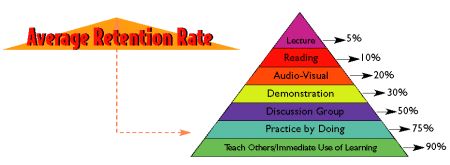
At the heart of all learning is the Piagetian lesson of learning
rooted in experience. As TILs, we must concentrate on the dual
role of practitioner and modeler. In this way, we can best hope to raise
the overall proficiency-level of our colleagues—thereby indirectly increasing
the amount of technology infusion in our curriculum.
|
|
|
Shamelessly stolen from http://www.infotoday.com/MMSchools/jan99/nellen.htm
|
The Three Tiers of Staff Development:
As TILs, I believe that we can help support our colleagues by close,
individualized mentoring. If the outcome of our DHS project is the creation
of learning unitsthat directly involve students in the curriculum
of our school, we must necessarily work with our colleagues to directly
address their professional teaching interests. The Curriculum Integration
Projects (CIPs) must be an outgrowth of the subject-matter areas for which
our teachers are responsible. It will not be sufficient merely to have
TILs conduct "workshops", in the traditional sense.
Technology, like most other aspects of human learning, involves distinct tiers of knowledge. These tiers I will artificially divide into three levels.
To teacha child about becoming more independently mobile, perhaps the place to start is to show them various ways to travel. Providing information about bicycles, taxis, skateboards, public buses and the Metrolink all help provide a level of awareness of the possibilities. Learning how to actually ride a bicycle is an operational skill; once mastered—with sufficient practice and doing—the learner can only then act on both her knowledge and skill in order to transform her life, improve her mobility, and finally let Mom and Dad stop being the chauffer!
My Contribution to the DHS Efforts as a TIL:
I believe that I can contribute to the overall success, in large part
because I have been instrumental in the DHSprocess from the outset.
While I will be chiefly responsible for the technical aspects of the DHS
infrastructure, I am interested in supporting the pedigogical goals of
the project and I have both experience in technology and science education.
My resumé details some of my past experience with teaching and learning:
<http://www.cusd.claremont.edu/~rmuir/Resume-career.html>
Within the broad categories cited above, here are some of the topics,
areas of interest, or specific content-area that I have experience in and
am prepared to offer to the DHS project as a TIL:
| Networking | Fileservers—use, management, and security |
| Network servers—WWW, mail, FTP, etc. | |
| Using dail-up networking (for home use) | |
| Managing accounts |
| Computers | Basic operations |
| Peripherals (printers, cameras, video) | |
| Basic troubleshooting | |
| System Software--maintanance and updates |
| Technology, Use and Policy | Basic principles, Internetworking |
| Institutional practices, AUPs, Netiquette | |
| Internet practices | |
| Using network resources |
| Networking | E-mail (Eudora, Netscape Mail, Outlook) |
| Client-server (FTP, telnet, WWW, etc.) | |
| Peer-to-Peer computing | |
| Groupware (calendars, listservs, conferencing) |
| Productivity software | AppleWorks |
| Multimedia/graphics/animation | |
| Office98 (Word, Excel, PowerPoint) | |
| Netscape Communicator w/ Composer, Calendar | |
| Graphics tools (digital still and video editing) |
| Science | Interactive Physics |
| Voyager | |
| Lego/Logo and Microcomputer-based Lab. | |
| Image analysis and imaging |
| Technology | Telecommunications |
| Internet publishing | |
| Conferencing | |
| Video and Multimedia authoring |
In addition, my involvement in the design, planning and writing of the DHS Project gives me a unique perspective on the process we are about to begin. I believe that my experience as a teacher and Mentor Teacher, CHS department chair, technology coordinator, my experience sitting on a variety of school committees, my twelve years as Adjunct Professor at the Claremont Graduate University, and my sixteen years of employment by the Claremont Unified School District gives me a good grasp of both the community and the school in which we begin this transformational project.
—Robs Muir.