
[Originally published in mOthEr rOck, Issue #10, January/February 1998. Copyright © 1998 mOthEr ROck/The AMCC Group. All rights reserved.]
mOthEr rOck: Robs, has climbing brought you fame and fortune?
Robs John Muir: When I was in high school and just getting started in climbing, fortune was never a part of the equation. Climbing was really a fringe thing, and the commercial aspects weren't too evident. I remember talking with Galen Rowell after his epic on the South Face of Half Dome; his heroism on new rock DID leave an impression on me as a sixteen-year old kid. Guys like Royal Robbins, Glen Denny, Warren Harding, Roper, Salathe, etc.-the big names of that time-were role models for us. The desire was to able to "touch" some of their handywork, and being able to do the stuff they could do, drove us on.
I suspect that those of us who started climbing in the Sixties were mostly interested in getting "good" for its own sake. Money was never even considered. Mastery was its own reward. This was undoubtedly a good thing, since I've certainly never seen any money!
The original motivation for me to get into such a deviate sport is lost to my feeble memory, but I was always interested in alternatives to team sport. Things like tennis, bicycle racing, and that kind of stuff. ...never tall enough for basketball, not big enough for football, not fast enough for track. Climbing offered an exciting, mentally stimulating alternative to mainstream stuff. And "alternative" was the operational term during the Summer of Love.
mOm: You first started climbing in October, 1968 in Berkeley. How did you first get introduced to this activity which would play a major role in your life ?
Robs: I had a buddy in High School who, like me, was into photography. We heard about a Kodak cinematography contest which we decided to enter. Of course this was the Sixties, so our film script had "deep" psychological and surreal overtones. We needed some appropriate footage and we recruited another student, who was a "rappeller", to slide down some of his cord (artistically backlit against the sun) which we would later post process with dayglo special effects. All very groovy stuff, you understand.
After we got the 8mm footage, he showed us how to rappel using his kit of multiple breakbars (probably just like they used in the Army or something) on a single strand of 7/16" goldline. Pretty heady stuff on the 100' sandstone crags of Mt. Diablo! Later, I went to the library and snagged everything I could find about climbing; I was quite shocked to learn that people really climbed UP cliffs. I though going down was the sport!
Back in the good old days, the Sierra Club actually taught climbing. So I joined the Berkeley RCS (Rock Climbing Section) and, over a six-month period, learned the ropes. Our culminating outing was the standard route on The Royal Arches in the Valley--our first trips onto the sharp end of the rope.
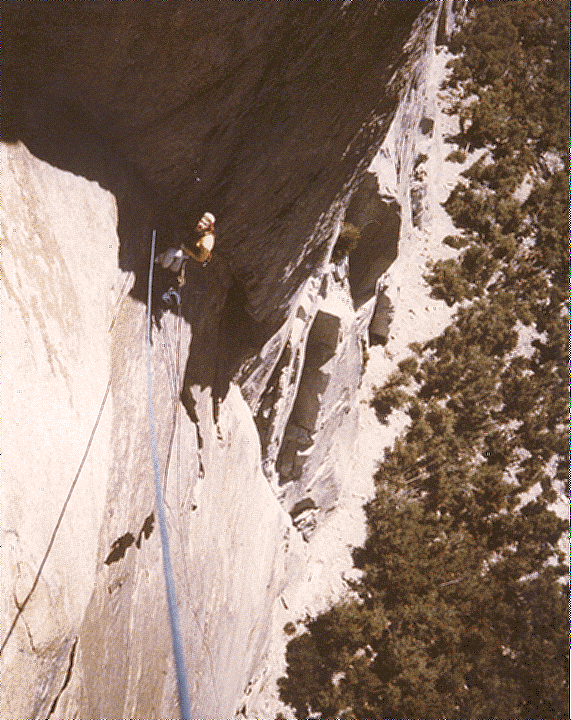 |
Cosmos (VI 5.10, A4), El Capitan, Yosemite, 1976. [310K]
The second ascent. This shot is taken from the top of the fifth pitch just prior to the beginning of the first pitch of A4 nailing. |
Later, I discovered that the way improve was to regularly boulder at Indian Rock in Berkeley and avoid the "social climbers" in the Sierra Club. Unlike the Southern California scene, Indian Rock was in a dense urban setting and there was a strong influence of tradition (dating back to the 1930s-40s) combined with a large group of regulars, so you would often see the same faces. Probably the closest thing we had to the Berkeley scene down here was Stoney Point during the same era.
Stoney had Chouinard, Robbins (before he moved to Modesto), and the West Ridge contingent--many of whom worked for Don Lauria. Indian Rock had regulars like Bruce Cooke, Al Steck, Galen Rowell, and a bunch of young whipper-snappers such as Dale Bard, Vern Clevenger, Ben Borsen, Peter Haan, and Chris Vandever. Later, we would see Robbins show up on Saturday mornings; he would drive over from Modesto--a several hour trip. Indian Rock encouraged a loyal following.
mOm: How did you wind up in Southern California? Please tell me it was because the climbing is so much better here than in Northern California...
Robs: I came down to go to college. I have an uncle who is a UC Berkeley professor and, while I wanted to go to Berkeley, he recommended that I go to a smaller UC as a freshman; so I chose UC Riverside. Later, Ben Borsen came to UCR to do graduate work and we exported the Berkeley traditions to Rubidoux. (At least, for a period in the early Seventies.)
I liked the Mediterranean climate down here and, although nothing compares to the unique rock of Berkeley, the granite was firm and clean. Tahquitz was much closer than the Valley was to the Bay Area, and we could climb throughout the winter down here. (Remember, indoor nerf climbing was not an option; climbing was exclusively an outdoor sport.) Plus, Rubidoux was a very local crag.
My first route here was Serpentine at Suicide, which I lead in Galibier RRs-a very stiff, lug-soled boot and a standard issue boot of the day. I was quite impressed with the Idyllwild offerings. Big Rock, at that time, was a place you could drive directly to and belay from the front bumper-with shade trees and everything-so I was so pleased with the local situation and the opportunities. ("An hour from the mountains, an hour from the beach, an hour from the desert, in the middle of nowhere.") With such year-round climbing, heading back to the Bay Area never seemed to attractive...
mOm: You used to spend a lot of time training at Rubidoux. When? With Who? What were you climbing? I'm sure you've got a thousands stories...
Robs: I met several Riverside locals initially. There was a climbing shop called the Highland Outfitter which helped create a focal point for climbing at the East end of the LA Basin. Guys like Jim Hoagland, Steve Toy, Dennis Bird, the Gleason brothers, along with John Long, Richard Harrison, Rick Accomazzo, Kevin Powell and Darrell Hensel, helped develop a unique local scene, albeit more of a commuter scene. For several years there, we had regular Tuesday/Thursday afternoon sessions at Rubidoux where we'd boulder till dark. The tradition was ropeless for the most part, and I recall that we had several problems that we vowed we would not do with a rope, keeping the game on a higher plane. (Indeed, these were all eventually worked-out despite scary groundfall prospects.)
One story, though... We had a bet with Paul Gleason, that no one could do the center route of what is now called the "Smooth Sole Wall" without smoothsole boots. It would be impossible to do it without 'em, we claimed. Paul tried for a month to do it in RRs, Kronhoffers, even SuperGuides, without success. Finally, he succumbed to peer pressure and new technology, and got a pair of PAs. Of course, he waltzed the thing the next day, and the name stuck. (Once he learned the moves, he did go back and do it in lugged boots just for spite.)
There are lots of stories, but John Long is a much better storyteller than I! His new book does a really credible job of creating the flavor of those days, and I highly recommend it.
It is unfortunate that the local traditions are not better preserved here in SoCal; with the long commutes, it's hard to maintain continuity. Names like Phil Haney, Oliver Moon, and Phil and Paul Gleason are legendary among us old farts, yet are unknown to the legions of modern Rubidoux habitues. Yet, we see all their problems in the modern guide books. I may raise the hackles of some of the new guard when I say this, but the hardest of problems at Rubidoux were done in the early- to mid-seventies, and these horrendously thin cranks still remain the hardest stuff either side of vertical. Standards are hardly much harder than they were back in the mid-seventies in the pure bouldering arena. (How's that for curmudgeonly baiting?!) This is not true for sport climbing, though...
mOm: Do you still get out to Rubidoux?
Robs: Yeah, but family and work mean that these trips aren't quite so casual or as frequent. Several of us usually grab chalkbags and boots, and together unconsciously recreate the camaraderie we've grown up with. I still see "boulderers", but more often I see harnesses and lycra on routes we're used to doing in tattered cotton shorts and not much else. This seems the new trend: to turn boulder problems into toproped sport routes. I'm sure it's safer...
We don't mean much by it, but it's been our standard form to continue to third-class the same stuff we've been doing for 20+ years. While, I sure that plays wrong to some in the audience, we are only carrying on the noble traditions that our predecessors modeled for us! (grin)
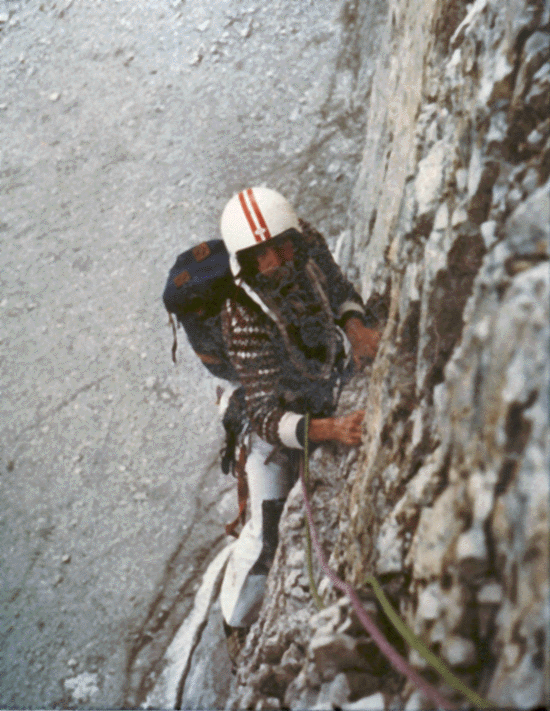 |
The Comici Route, Cima Grande, Tre Cima di Laverado, Italy, 1977. [298K]
Under variable weather (it rained on the descent), we managed to follow all pitches free. This picture was snapped somewhere on the third pitch (?) before the wall switches from merely vertical to overhanging limestone. |
mOm: Did you do the first ascent of The Beach Problem at Rubidoux? It's right next to one with your name on it...
Robs: The only "Beach Problem" I know of at Rubidoux was put up by Ben Borsen and me back in 1970/71. We didn't call it that, back then. The name got changed after we started working out at Pirate's Cove down in Corona Del Mar (where Ricky Accomazzo and I shared a house during college). The low start just felt like a Rubidoux equivalent of Diamond Man... Lynn Hill and I worked out some cool eliminates to "up" the interest level. I also managed to do the Beach as a one-arm problem, avoiding the overhang by starting just left of the usual sit-down start; Largo is the only one to have repeated it to my knowledge. At least I witnessed this Largo claim, so we can trust its veracity!
mOm: You're the founding member of the Stonemasters, because you did the first continuous lead of Valhalla, 5.11a, at Suicide (in the Spring of 1972). How exactly did the Stonemasters get started--by accident, by design, or by destiny?
Robs: Towards the end of my second year at UCR, I was feeling pretty comfortable with SoCal granite. I was living in a house with several other climbers, and Jim Hoagland and I began testing the hard new routes at Suicide that Bud Couch had been constructing with his (older) friends. Once we realized that things like Sundance, the Iron Cross, and Chingadera (at Tahquitz) were do-able, we began pushing hard faces with our smooth-soled boots like PAs, EBs, and (later) Fires.
Rubidoux, in addition to being a bouldering haunt, became a place where we would practice moves we imagined to be like the cruxes on the routes we "wanted" in Idyllwild. The hottest thing on the planet (to our way of thinking) was the new Couch route, Valhalla. They had done all the hard work of placing the bolts and done each individual pitch, but (we believed) that Couch, Larry Reynolds and Mike Dent had still to do the first continuous ascent. We waited, for a suitably respectful length of time, but the stylish single push didn't come. The rumor was, this puppy was the first 5.11 face in the US, and was harder than other face route in the Valley. Since we were on a roll, having just done an early ascent of the Iron Cross, we started loitering around under Valhalla.
Hoagland was a quiet, very intense boulderer and the first pitch of Valhalla looked to us like a boulder problem. With a HUGE aura. So, one afternoon, we clipped the first bolt and several falls later, we found ourselves at the end of the first pitch.
The next weekend, I led the first pitch without a fall, so we were clearly learning the moves. Jim took several longish whippers on the crux of the second pitch, and we bailed later, quite mentally initimidated. (Couch, by the way, had numerous times happened below "his" routes to see us kids; both Jim and I were quite cowed by his presence. Largo does a good job painting the tension we budding Stonemasters felt.) A week or two later--after serious bouldering sessions at Rubidoux--we returned with very calloused tips. Jim also brought along a different shoe for each foot--a stiff one for that too-small, sharp edge on the crux.
 |
"Boulder. There is no substitute for touching stone, no 'training' that can take the place of rock sense." |
When Jim, Steve Toy and I worked-out the moves to Valhalla and eventually completed the route without falls on the third attempt, we had arrived-in our none-too-humble opinions. I think we really frustrated Bud Couch who wanted to finish Valhalla in one go; but he had left the route stand for many months, and we felt justified. It didn't help to have a dozen later ascents happen almost overnight, by a ragtag bunch of kids who hadn't paid any serious dues yet. But such is youth.
I transferred down to UC Irvine that Fall. There, I met even younger lads like Mike Graham, Steve West and Tobin Sorrenson. We were working at a ski and climbing shop in Newport Beach, and during the many slow times we would talk "rock." Grammicci got the idea into his head that Valhalla should serve as a the rite of passage for the truly hard. He even collected a list of the first dozen or so ascents. The idea arose among us that we should label the "in crowd" accordingly; hence the Stonemaster moniker. Mike even chose a lightning bolt as a logo. (You gotta remember that this was a beach town, so the surfing mindset was inbreed in these guys.)
When Ricky Accomazzo joined the UCI crowd and also got hired at Ski Mart, we really had a nucleus. Originally, the plan among some was to limit the Stonemaster roster to those who were on the first ten ascents of Valhalla, but no one took this seriously. Basically, if you were among the clique you were in. So anyone with merit, who frequented the crags and pitched their tent in the movable, communal campsite, could wear the metaphoric badge.
We would jokingly form impromptu Stonemaster trips to El Grand Trono Blanco or to J-tree or to Granite Mountain (Not the one in Prescott!), bag lots of new routes, have thrilling adventures and never tell our parents--because they would never understand. We would hold mass ascents of new routes in Idyllwild--sometimes with six or eight in the party--just because someone mentioned a new project and the rest of us had no other plans for the day. I even remember us doing silly things like mass free-solo ascents of "The Open Book"!
mOm: Valhalla is legendary, and is about to celebrate its 25th anniversary. In 1998, does it live up to the legend you helped create in 1972?
Robs: I'm not convinced that legends are consciously created unless one can manipulate the media. Clearly, we Stonemasters spun a few yarns over the years, but the climbing community jointly and collectively crafts its own mythologies over time. Valhalla is a quality route and set new precedents for difficulty; it ushered in a new era of thin face climbing. For that, Bud Couch deserves far more recognition in the historic pantheon than the present mythology includes. And there are other, bolder leads around; but Valhalla remains a lovely milestone in California climbing. ...kind of like the Open Book marks Robbins' trendsetting first 5.9, or Cenotaph Corner (in Wales) fits into British climbing history.
mOm: Is there any secret beta on Valhalla you can share with the readers of mOthEr rOck?
Robs: Uh... No. There really isn't any secret. The glory of that route is that everything is so out in the open, with nothing to hide. (But, to truly enter the land of Valhalla, you must climb directly between the two larger knobs on the third pitch...)
mOm: When's the last time you climbed Valhalla?
Robs: Damned if I can remember. Probably in the late seventies... We used to do it quite regularly.
mOm: You also used to train at the Mt. Baldy Boulders, which in recent years have been plagued with access problems. Do you still go there?
Robs: You bet. However, I gotta take notice of your word, "train". Back then, we never trained. We went climbing. It was not a means to an end; it was the end.
There has been a bit of a resurgence there lately, though access remains a problem. It's wonderful...every ten years, someone rediscovers old Harrison or Largo problems, and claims them as first ascents. Which, in a way, they are. This area was originally developed by Paul Gleason and he shared the secret with us back in 1971/72. Even I keep rediscovering stuff we were doing 25 years ago! I look forward to even more first ascents as my Alzheimers progresses.
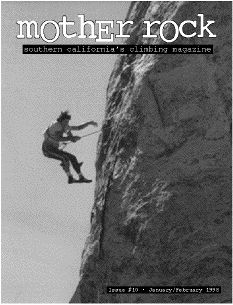
mOm: Tell me about Flying Circus, 5.11b A4, at Tahquitz, which you climbed with Rick Accomazzo in August, 1978 (pictured on the cover of this issue).
Robs: Ricky had been looking at that area to the right of the Green Arch for quite some time. I thought it looked like a daft project, with some obvious and scary aid. But Charles Cole, Ricky and I were coming down from something else, walked underneath it, and decided to waste some time scoping it out. After a quick 40 feet of pretty cool moves, the wall really overhangs, the crack peters out, and the start of more familiar (though steep) face climbing looked within reach. There was just that little aid bit. But the upper face looked really sound!
We came back the next weekend, Ricky did some very shaky overhanging hook moves off a RURP and eventually sank a bolt above the overhanging bit. We left a 9mm cord fixed, so that we could come back the next weekend and carry on. Interestingly, the next Saturday we discovered that some scumbag had cut the cord about six feet above the ground, and the wind had lofted the remainder onto some knobs WAY of the deck over by "Ski Tracks"! It took us a very long time to lasso the rope. Rick did some really stout face moves up to the hanging belay; that was the end of the day for us.
On the third weekend, it was my turn to explore second pitch. Chuck stayed on the ground to snap photos--he would eventually jumar up to the belay stance so that he could finish as well. I took on very long fall of about 40 feet or more in a effort to place the bolt above a good sized knob; the second effort got me onto the knob. So Rick decided to christen that pitch "The Muir Trail."
mOm: Any thoughts on why, 20 years later, nobody has nabbed the second ascent of Flying Circus? Do you have any desire to go out there and climb this again?
Robs: Chuck went back with Gibb Lewis and traversed in to the section above the aid, I'm told, from the right. But, you're right. I don't know of anyone who has repeated the Circus properly. I've actually had someone in the last year or so ask me if I wanted to climb Flying Circus. I politely told him that I had already done it, and had absolutely no interest in absorbing that much adrenaline in one dose! Another obscure, little-repeated route at Tahquitz is The Hangover (5.12). It's a whole lot safer than the Circus, yet it too is about 20 years old. But the numbers and the difficulty of these routes have far less impact on me now than the people and the experiences of those times.
mOm: Were there any "almost" Stonemasters, guys who were trying to climb Valhalla, but couldn't do it, and never quite made it into the "club?"
Robs: Naw. It was never like that. If you had the moxie, you were a Stonemaster. No dues, no cards, no club. Just a wry poke at the mountaineering clubs of the past...
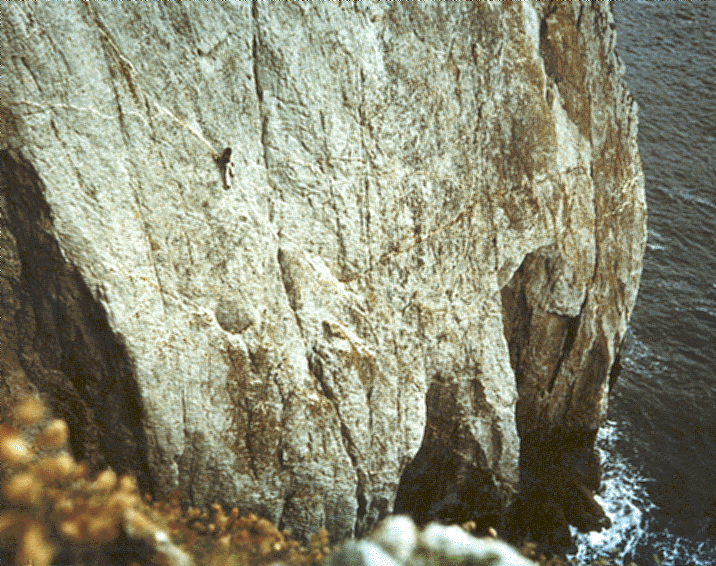 |
Quartz Icicle (HVS), Wen Zawn, Hollyhead, Wales, 1977. [374K]After rapping down to the North Sea, we climbed out crossing the Dream of White Horses. |
mOm: As a group, did the Stonemasters die, or just fade away? When did it come to an end? Are you still in contact with any of the guys?
Robs: Some (sadly) died, some have faded, and some climb stronger (Well... maybe wiser.) than before. We sometimes run into each other at the crag, and we sometimes exchange Xmas cards. Access Club meetings are sometimes a draw and, several years ago, a photo was taken of some of the motley crew. Like the mountains we all love, the experience of climbing is highly personal. My experience so far is that the shared bonds we enjoyed years ago were hard tempered with fire. I expect them to remain intact if not strengthen over time. Back in Berkeley, I remember watching old guys in their 60s and 70s, slowly bicycle to Indian Rock and then proceed to whip off 20 fingertip pullups on Lichman's Lick, as we called it. Shaming us all. I wish there were more role models like that today; those guys gave me hope that climbing isn't only a young person's sport, but something we can do for a long time.
mOm: It seems like lately you spend a lot of your summers up in the Eastern Sierra, at your cabin, doing some mountaineering and putting up new routes?
Robs: Not so much mountaineering, but technical rock routes in the backcountry... Great adventure, wonderful scenery, and zero posing and posturing. The Whitney Portal has really courageous ground-up routes of really spectacular quality in some cases, and absolutely no crowds. Plus, I can take a shower afterwards!
mOm: Do you follow current climbing news? What do you think of some of the amazing young climbers like Chris Sharma and Katie Brown, or our very own local, Matt Hoch?
Robs: Sorry, but I find most the climbing mags really lacking in the celebration of the process. It's kinda funny, but this interview is just the type of stuff that I would never read in the "fashion rags" coming out of Colorado. I remember walking with Johnny up at Rubidoux and marveling at the sheer, embarrassing idolatry that some climbers demonstrated, once they recognized Largo's mug from the back of his books! I don't know Chris, Katie or Matt, but I'm guessing that they probably won't continue long climbing if celebrity status is their primary goal. The rocks--and the friendships made along the way--will be here long after the ink has dried and the newsprint has faded.
mOm: What's the best route you've ever done in California?
Robs: The last one. Always the last one! (In this particular case, a wonderful trip this Fall in to Charlotte's Dome.) Superlatives really don't apply when the experiences are individually unique.
mOm: What's number one right now on the Robs Muir list of must-do climbs?
Robs: Probably getting off the couch to do another big wall. I was looking at El Capitan from the meadow recently, and thought that its been too long...
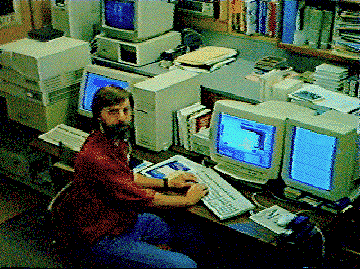 |
Robs at work: "Seems like the 'Net is just another new frontier to explore--not unlike Tahquitz in the Seventies..." |
mOm: In 1990 and 1991, you participated in a few So Cal indoor climbing contests, didn't you?
Robs: As a lark. I have access to a few indoor walls where I can go to loosen up and, for a while there, I thought the competition stuff was cute. But lately I've come to the opinion that the bouldering comps and such are OK only if people can avoid taking them seriously. For the younger set, this is sometimes not easy. Gawd, I'd hate to see climbing become like skateboarding! I can just see the ESPN-2 coverage now...
mOm: You're considered one of the elite of the climbing community. Does that carry any burden? Does it in any way interfere with your ability or desire to "just go climbing?"
Robs: Something is only a burden, if you decide to carry it. There are so many better climbers than I, who work much harder than I do, to do what they do so well. They rightly carry that mantle. This late in the game though, I really value my precious time at the crags. It's a pleasure to avoid the trappings and "just go climbing".
mOm: Climbing has changed a lot in the last couple of decades: hi-tech gear, sticky rubber, rap-bolted sport routes, greatly increased popularity, etc. In your opinion, have these changes resulted in positive or negative effects on climbing?
Robs: I once had favorite shoes in for a resole job and decided to take an old pair of EBs out the Rubidoux. Scared myself silly on even moderate problems! A lot of newer gear has justifiably replaced older stuff... I tend to gravitate towards routes that have been done from the ground-up and I'm far less interested in sport routes. Difficulty for difficulty's sake on longer routes doesn't attract me anymore. (Time is a factor, but so is my pride. Those new routes are really impressive!)
Bouldering is a different matter, though; I still like working-out those short, hard problems. I don't think you'll get me to denigrate the new, and pine-away for the "good old days." Change brings both negative and positive effects. I do miss the celebration of boldness, though.
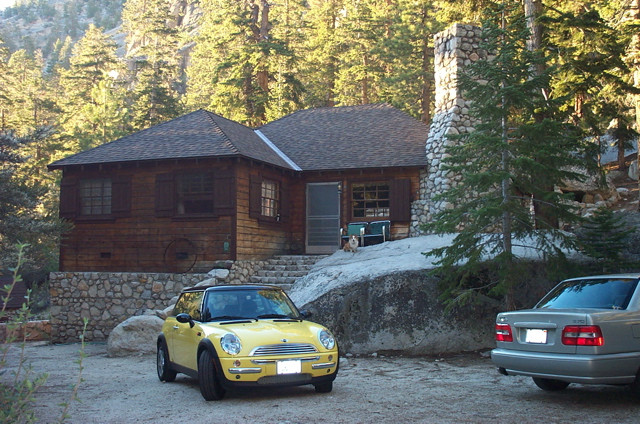 |
Summers in the Sierra...the Muir cabin. |
mOm: What keeps you busy these days?
Robs: I have been teaching physics and computer education courses and I also teach graduate courses during the Summer. More recently, I have become a Systems Administrator and Network Manager for the school district where I live. Seems that I spend more time in phone closets and on keyboards that REAL stuff like family and friends.
mOm: Sounds quite different from climbing...
Robs: I get to deal with all sorts of events. On one day a few months ago, I personally received more than 3,500 E-mail messages during a spamming attack, but managed to keep the systems alive! Within the next 18 hours, I managed to track the twit to a dialup port of an internet service provider on the East Coast. They were able to identify the jerk, but couldn't release the name without a search warrant. So, there I was, calling Reston, VA and talking with an FBI dude getting the skinny on how to prosecute. Gawd, I could tell the Special Agent was wearing aviator shades even over the phone!!! Seems like the 'Net is just another new frontier to explore--not unlike Tahquitz in the seventies...
mOm: What about your family? Do you take your young sons climbing?
Robs: Michael and Galen are mildly interested, but soccer and other diversions are more important to them. They've spent quite a bit of their pre-walking days in the child carrier at the base of climbs, so they've learned that climbing isn't much of a spectator sport! If (or when) they're ready, they know where the gear is. Extrinsic motivation is no substitute for the intrinsic kind. Plus, they'll always have a climbing partner when they're ready.
mOm: What advice would you give a young climber starting out today?
Robs: Boulder. There is no substitute for touching stone, no "training" that can take the place of rock sense. And the only way to build that subconscious skill-set is to move on real rock. If you leave the gear at home sometimes and reduce the sport to its essence--a chalkbag, sticky edges and a few friends--the activity really gets internalized.
Oh. And, as Bob Dylan said, "Don't follow leaders; watch for parking meters."
mOm: Thanks, Robs, for taking the time to talk to the readers of mOthEr rOck!
Robs: Cheers.
return to mOthEr rOck Magazine On-Line
Questions? Comments? Send E-mail to mOthErrOck_NOSPAM@aol.com.